Discoveries
Sixteen official surprises in a cylinder
A motor that lost a quarter of its power as it warmed, a cam that turns once while the crank turns twice, and a 1911 engine that, Clerk said, got its impulse without explosion. These are official details, not workshop gossip.
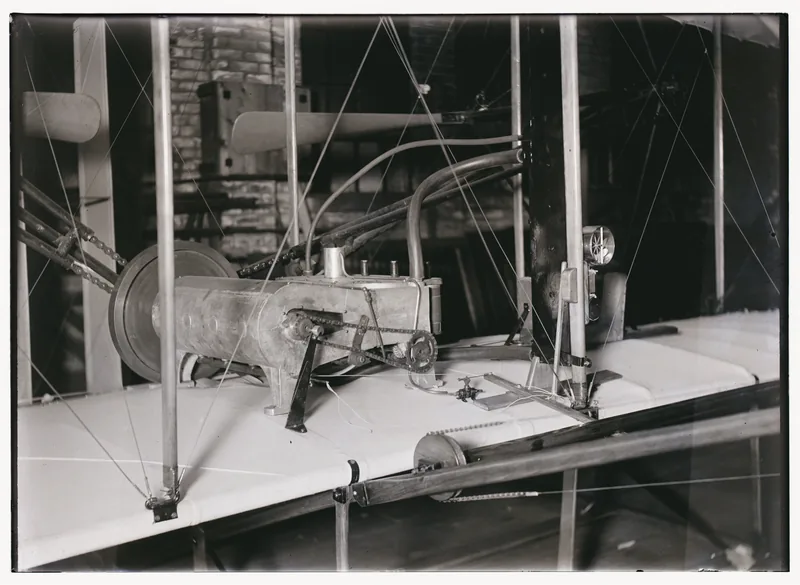
Sixteen horsepower, then twelve
NASA gives the Wright 1903 engine a small, time-bound rating: “about 16 horsepower when the engine was first started to about 12 horsepower when it was running hot.” The figures are not treated here as a general rule for other motors. [source]
A make-and-break, not a modern plug
The official mechanical-operation page keeps two Wright-specific details in the ignition and the valves: an automatic intake valve, and a “make and break” ignition, “not a modern spark plug.” [source]
Each cylinder breathed out on its own
“Exhaust exited each cylinder independently,” NASA says of that engine. There is no official attempt here to tidy the plumbing into a later manifold. [source]
Two turns of the crank, one of the cams
“The crankshaft makes two revolutions for every one revolution of the cams.” A four-stroke secret, hidden in a ratio. [source]
Two propellers, turning opposite ways
The same page describes one cylinder of a four-cylinder motor, “each piston connected to a common crankshaft,” and that crankshaft “connected to two counter-rotating propellers.” [source]
The cycle had a German year
The Wright design, NASA says, “was based on early automobile engine designs which used the Otto cycle, developed by the German, Dr. N. A. Otto, in 1876.” [source]
A museum engine that is not the prototype
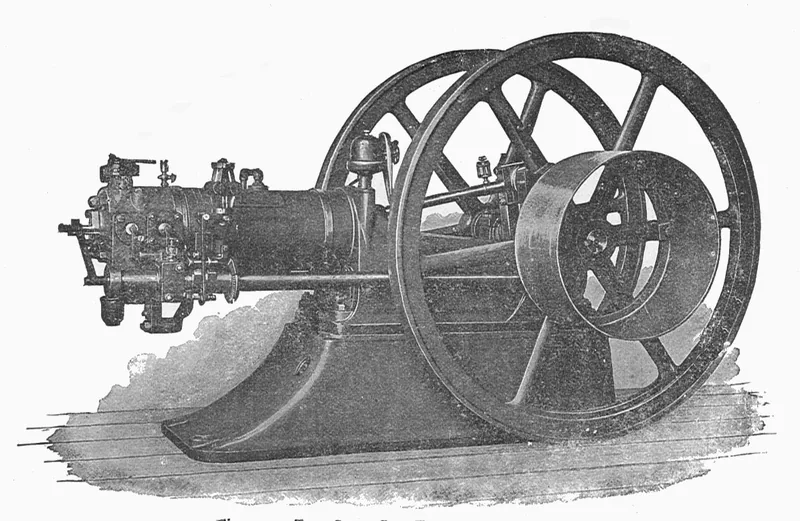
The Crossley Brothers coal-gas engine at the Tekniska museet, object TM7415, is based on Otto’s design and was manufactured in the years 1876–1910. It is a later workshop machine, not Otto’s 1876 prototype.
A fire that happens “very quickly”
On NASA’s ideal Otto-cycle diagram, combustion at stage 3 “occurs very quickly and the volume remains constant.” The official page then warns that the ideal cycle does not occur in reality. [source]
Four strokes, or four processes
NASA names four piston strokes: intake, compression, power, exhaust. The Department of Energy, of engines currently in production, lists four processes: “intake, compression, combustion and power stroke, and exhaust.” The two official groupings sit side by side on this site. [source] [source]
Two kinds, currently in production
The Department of Energy names “two kinds of internal combustion engines currently in production: the spark ignition gasoline engine and the compression ignition diesel engine.” Most of these, the same sentence says, are four-stroke cycle engines. [source]
A diesel that takes in only air
In a diesel engine, the Department of Energy says, “only air is inducted into the engine and then compressed.” The fuel arrives later, as a spray into that hot air, “at a suitable, measured rate, causing it to ignite.” [source]
An impulse without explosion
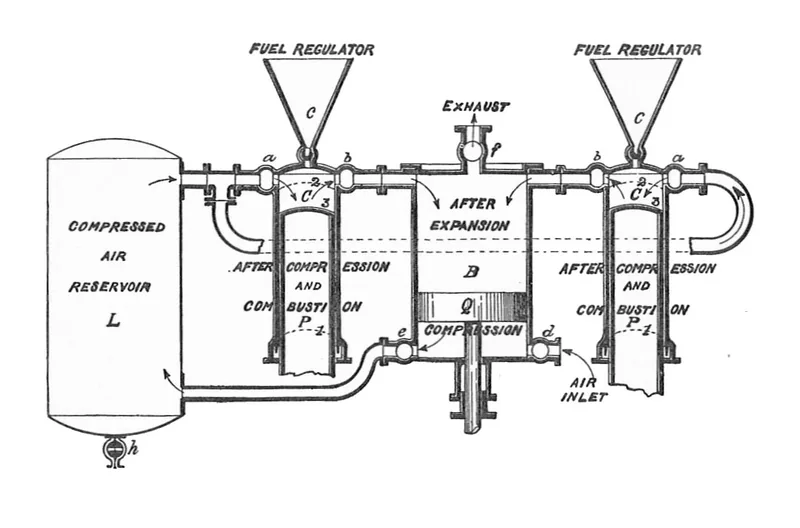
Clerk, in 1911, wrote that Diesel’s oil “ignites at once as it enters the combustion space, and so a power impulse is obtained, but without explosion. The pressure does not rise above the pressure of air and oil injection.” [source]
Air raised to incandescence
The same article says compression was “generally to over 400 ℔ per sq. in.,” and that this “raises the air to incandescence,” after which oil is injected “by a small portion of air compressed to a still higher point.” [source]
A 1921 temperature, kept to its page
Collier’s New Encyclopedia (1921) gives a four-stroke Diesel compression of “450 pounds per square inch” and a temperature of “about 550 degrees C.” Those figures are not combined with Clerk’s “over 400 ℔.” [source]
Up to 1000 horsepower, in 1911 wording
Clerk wrote that the Diesel engine was “made on the continent, in England and in America in sizes up to 1000 H.P.” The sentence is left in 1911, not updated into a modern catalogue. [source]
A test that names its tester
From a test of a 500 B.H.P. Diesel oil engine by Michael Longridge, Clerk reported three cylinders, 22.05 in diameter, 29.52 in stroke, indicated power 595 horse, brake 459, mechanical efficiency 77%, indicated thermal efficiency 41%, brake thermal efficiency 31.7%. The figures belong to that test only. [source]
Enjoyed this piston-engine desk?
No pop-ups. No intrusive advertising. Just interesting stuff. A little support helps the next mechanics.im site get built.