Questions
Questions people actually ask
Short official answers, kept in the wording of the pages they come from.
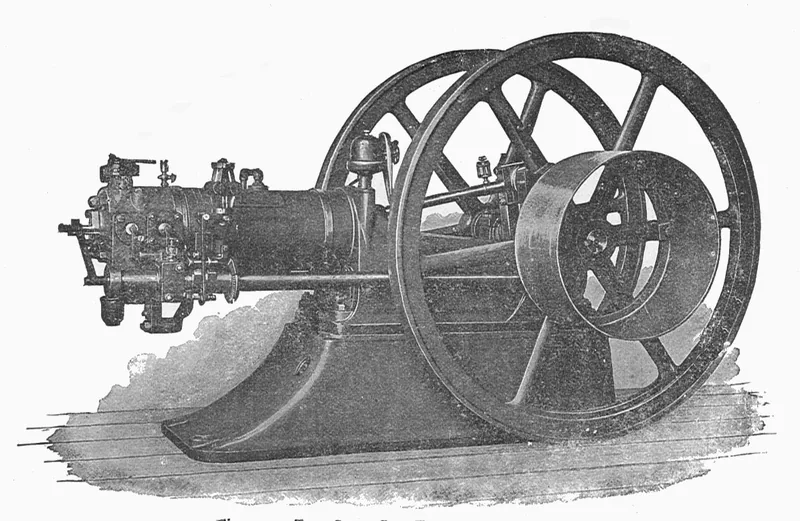
Why is it called a four-stroke engine?
NASA’s wording is plain: “The engine is called a four-stroke engine because there are four movements (strokes) of the piston during one cycle.” Those strokes, on the mechanical-operation page, are intake, compression, power and exhaust. [source] [source]
Who was Otto, and why does his name keep appearing?
NASA says the Wright brothers’ design was based on early automobile engine designs which used the Otto cycle, “developed by the German, Dr. N. A. Otto, in 1876.” Clerk, in 1911, still used “the Otto cycle” as a name even when writing about Diesel engines. [source] [source]
How did the Wright 1903 engine start a fire in the cylinder?
NASA says a spark ignites the mixture on the power stroke, and notes that the ignition was a “make and break” ignition, not a modern spark plug. [source]
Why does NASA give two horsepower figures for the same engine?
Because the official sentence is about heat as well as power: “about 16 horsepower when the engine was first started to about 12 horsepower when it was running hot.” [source]
What is the difference between a petrol engine and a diesel engine?
The Department of Energy’s short official answer is about how the fuel arrives and how it ignites. In a spark-ignition gasoline engine the fuel is mixed with air, inducted, compressed, and ignited by a spark. In a diesel, only air is inducted and compressed, and the fuel is sprayed into that hot air “at a suitable, measured rate, causing it to ignite.” [source]
Did early Diesel engines explode the charge?
Clerk’s 1911 wording is the opposite of that picture: “a power impulse is obtained, but without explosion.” [source]
Is every Diesel a four-stroke engine?
Not in the official encyclopaedia wording quoted here. Clerk wrote that the engine “operates generally on the Otto cycle, but it is also built giving an impulse at every revolution.” Collier’s, in 1921, said it was made in two types, four-stroke and two-stroke. [source] [source]
Why do 400 pounds and 450 pounds both appear on this site?
Because two official sources give two figures, and this site does not average them. Clerk, in 1911, wrote “generally to over 400 ℔ per sq. in.” Collier’s, in 1921, wrote “450 pounds per square inch.” The field-notes page keeps the distinction. [source] [source]
Does the ideal Otto-cycle diagram show a real engine?
NASA says the page shows an ideal Otto cycle, and that “in reality, the ideal cycle does not occur.” [source]
Where do the photographs come from?
From Wikimedia Commons, with licences checked on each file page on 17 November 2026. Captions say when a picture is a later museum engine, a book plate, or a 1928 photograph of a 1903 motor. Credits are listed on the credits page. The free fact sheets have no photographs.
Enjoyed this piston-engine desk?
No pop-ups. No intrusive advertising. Just interesting stuff. A little support helps the next mechanics.im site get built.