Myths versus facts
What this site will not pretend
A few confident sentences travel with piston engines. The official pages are often more careful, and sometimes more surprising, than the sentence that gets repeated.
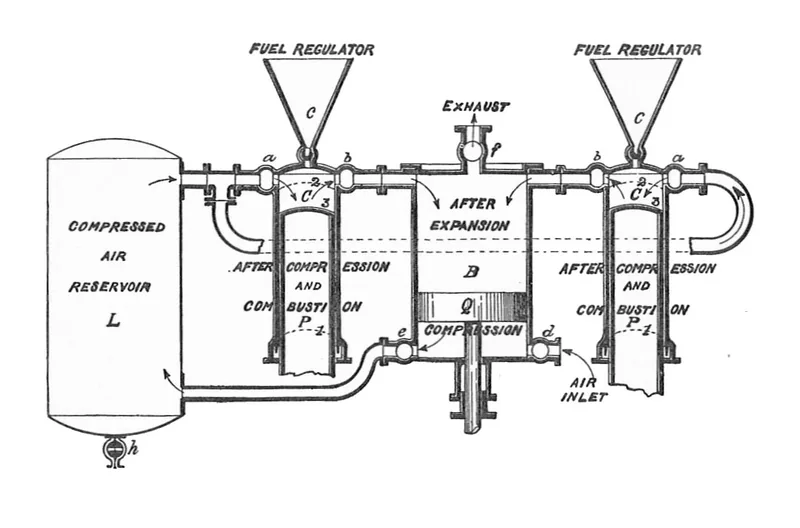
Myth: Every internal-combustion engine is a four-stroke engine.
What the sources say. The Department of Energy says that most engines currently in production are four-stroke cycle engines, “meaning four piston strokes are needed to complete a cycle.” Clerk, in 1911, wrote that the Diesel engine “operates generally on the Otto cycle, but it is also built giving an impulse at every revolution,” and Collier’s, in 1921, said the Diesel was made in two types, four-stroke and two-stroke. This site does not flatten those official sentences into “all engines are four-stroke.” [source] [source] [source]
Myth: A diesel engine uses a spark plug, just as a petrol engine does.
What the sources say. The Department of Energy says the two kinds “differ in how they supply and ignite the fuel.” In a diesel, “only air is inducted” and compressed, and the engine then “spray[s] the fuel into the hot compressed air at a suitable, measured rate, causing it to ignite.” Clerk wrote that Diesel’s engine “dispenses with the usual igniting devices by rendering the air charge incandescent by compression.” [source] [source]
Myth: The Wright 1903 engine made a steady 16 horsepower.
What the sources say. NASA gives a range tied to heat: “about 16 horsepower when the engine was first started to about 12 horsepower when it was running hot.” [source]
Myth: The Wrights invented the four-stroke Otto cycle.
What the sources say. NASA says their design “was based on early automobile engine designs which used the Otto cycle, developed by the German, Dr. N. A. Otto, in 1876.” [source]
Myth: The Crossley engine in the photograph is Otto’s 1876 prototype.
What the sources say. The Commons file, and the museum label it records, identify object TM7415 at the Tekniska museet as a Crossley Brothers four-stroke coal-gas engine based on Otto’s design, manufactured 1876–1910. It is a later engine, not the prototype.
Myth: The 1928 photograph of the Wright motor was taken in 1903.
What the sources say. The Library of Congress file is a 1 January 1928 photograph of the 1903 engine section, taken in the shop before shipment to the Science Museum in London, and attributed to Orville Wright. It is a later photograph of an earlier motor.
Myth: Diesel’s engine worked by a violent explosion in the cylinder.
What the sources say. Clerk, in 1911, wrote that “a power impulse is obtained, but without explosion,” and that “the pressure does not rise above the pressure of air and oil injection.” [source]
Myth: One official compression figure can be given for every early Diesel.
What the sources say. Clerk wrote “generally to over 400 ℔ per sq. in.” Collier’s, in 1921, gave “450 pounds per square inch” and “about 550 degrees C.” This site keeps those wordings on their own pages and does not average them. [source] [source]
Myth: The ideal Otto-cycle diagram is a picture of a real running engine.
What the sources say. NASA says, “On this page we have shown an ideal Otto cycle… In reality, the ideal cycle does not occur…” [source]
Myth: A modern spark plug is what the Wright motor used.
What the sources say. NASA’s mechanical-operation page says the ignition was a “make and break” ignition, “not a modern spark plug.” [source]
Myth: The Department of Energy page is a history of 1876.
What the sources say. The page describes engines “currently in production.” Otto’s year comes from NASA’s Otto-cycle page, not from that Department of Energy article. [source] [source]
Myth: Jet engines are a kind of piston engine.
What the sources say. This site does not say that. The official NASA pages quoted here are about internal combustion engines with a piston and a crankshaft. A sister site, jet-engines.mechanics.im, takes up the later official story of the gas turbine.
Enjoyed this piston-engine desk?
No pop-ups. No intrusive advertising. Just interesting stuff. A little support helps the next mechanics.im site get built.