Fact file
A desk of official piston-engine facts
Every fact below is taken from a named official page or a public-domain encyclopaedia article, and is kept in that source’s wording. Figures from different pages are not averaged.
- NASA says that in an internal combustion engine, fuel and air are ignited inside a cylinder. [source]
- The hot exhaust gas, NASA says, pushes a piston in the cylinder which is connected to a crankshaft to produce power. [source]
- The engine is called a four-stroke engine, NASA says, because there are four movements (strokes) of the piston during one cycle. [source]
- The Wright brothers used a gasoline-powered, four-stroke, internal combustion engine to power their aircraft. [source]
- The brothers’ design was based on early automobile engine designs which used the Otto cycle, developed by the German, Dr N. A. Otto, in 1876. [source]
- On NASA’s ideal Otto-cycle diagram, intake (1–2) is at pressure near atmospheric, with volume increasing as fuel and air are drawn in. [source]
- Compression begins, NASA says, with the closing of the intake valve (2–3): volume decreases, pressure increases. [source]
- Combustion, at stage 3 on that diagram, “occurs very quickly and the volume remains constant.” [source]
- During the power stage (4–5), NASA says, the gas does work on the piston. [source]
- At stage 5 the exhaust valve opens and pressure returns to atmospheric at constant volume. [source]
- The exhaust stroke (6) decreases the volume at constant pressure, returning the cycle to stage 1. [source]
- NASA warns that the page shows an ideal Otto cycle, and that “in reality, the ideal cycle does not occur.” [source]
- NASA’s mechanical-operation page describes one cylinder of the Wright 1903 aircraft engine. [source]
- That engine had four cylinders, each piston connected to a common crankshaft. [source]
- The crankshaft was connected to two counter-rotating propellers. [source]
- On the intake stroke the intake valve is open, fuel and air are drawn in, and the exhaust valve is closed. [source]
- On the compression stroke both valves are closed and the mixture is compressed. [source]
- On the power stroke a spark ignites the mixture; combustion is in a nearly constant-volume closed vessel; high pressure drives the piston. [source]
- On the exhaust stroke the exhaust valve is opened by the cam and rocker arm, and the spent exhaust is cleared. [source]
- The Wright engine’s intake valve was automatic. [source]
- Its ignition was a “make and break” ignition, not a modern spark plug. [source]
- Exhaust exited each cylinder independently. [source]
- “The crankshaft makes two revolutions for every one revolution of the cams.” [source]
- NASA gives that engine “about 16 horsepower when the engine was first started to about 12 horsepower when it was running hot.” [source]
- Those Wright horsepower figures are not generalised on this site to other engines. [source]
- The Department of Energy says that in an internal combustion engine the ignition and combustion of the fuel occurs within the engine itself. [source]
- The engine, that page says, then partially converts the energy from the combustion to work. [source]
- The engine consists of a fixed cylinder and a moving piston. [source]
- The expanding combustion gases push the piston, which in turn rotates the crankshaft. [source]
- There are two kinds of internal combustion engines currently in production: the spark ignition gasoline engine and the compression ignition diesel engine. [source]
- Most of these, the Department of Energy says, are four-stroke cycle engines, meaning four piston strokes are needed to complete a cycle. [source]
- The Department of Energy lists four distinct processes: intake, compression, combustion and power stroke, and exhaust. [source]
- Spark ignition gasoline and compression ignition diesel engines differ in how they supply and ignite the fuel. [source]
- In a spark ignition engine, the fuel is mixed with air and then inducted into the cylinder during the intake process. [source]
- After the piston compresses the fuel-air mixture, the spark ignites it, causing combustion. [source]
- The expansion of the combustion gases pushes the piston during the power stroke. [source]
- In a diesel engine, only air is inducted into the engine and then compressed. [source]
- Diesel engines then spray the fuel into the hot compressed air at a suitable, measured rate, causing it to ignite. [source]
- The Department of Energy’s page describes engines “currently in production”; it is not treated here as a history of 1876. [source]
- Clerk, in the 1911 Encyclopaedia Britannica, wrote that in Diesel’s engine “air alone is drawn into the cylinder on the charging stroke.” [source]
- The air, he wrote, “is compressed on the return stroke to a very high pressure generally to over 400 ℔ per sq. in.” [source]
- This compression, Clerk said, “raises the air to incandescence.” [source]
- Heavy oil is then “injected into the incandescent air by a small portion of air compressed to a still higher point.” [source]
- “The oil ignites at once as it enters the combustion space, and so a power impulse is obtained, but without explosion.” [source]
- “The pressure does not rise above the pressure of air and oil injection.” [source]
- Clerk called two features “very original”: very high compression pressures, and the dispensing with “the usual igniting devices.” [source]
- The Diesel engine, he wrote, “operates generally on the Otto cycle, but it is also built giving an impulse at every revolution.” [source]
- In 1911 he wrote that it was “made on the continent, in England and in America in sizes up to 1000 H.P.” [source]
- That “1000 H.P.” wording is left as 1911 wording, not a modern rating. [source]
- Clerk reported figures he calculated from a test of a 500 B.H.P. Diesel oil engine by Michael Longridge. [source]
- That test engine had three cylinders, 22.05 in diameter, 29.52 in stroke, each on the “Otto” cycle. [source]
- Clerk gave the indicated power as 595 horse and the brake power as 459. [source]
- He gave the mechanical efficiency as 77%. [source]
- He gave the indicated thermal efficiency as 41%. [source]
- He gave the brake thermal efficiency as 31.7%. [source]
- Those Longridge-test figures are not treated here as a general Diesel efficiency. [source]
- Collier’s New Encyclopedia (1921) says that in the Diesel engine, air is drawn into the cylinder and compressed, and then oil is injected as a fine spray and burned gradually. [source]
- Collier’s says the engine was made in two types, the four-stroke and the two-stroke. [source]
- In Collier’s four-stroke account, air is drawn in on the first stroke and compressed on the second to a pressure of 450 pounds per square inch. [source]
- Collier’s says this sudden increase in pressure causes a rise in temperature to about 550 degrees C. [source]
- During part of the third stroke, Collier’s says, oil is injected and, owing to the high temperature, ignites. [source]
- Collier’s 450 psi and “about 550 degrees C” are not combined on this site with Clerk’s “generally to over 400 ℔ per sq. in.” [source]
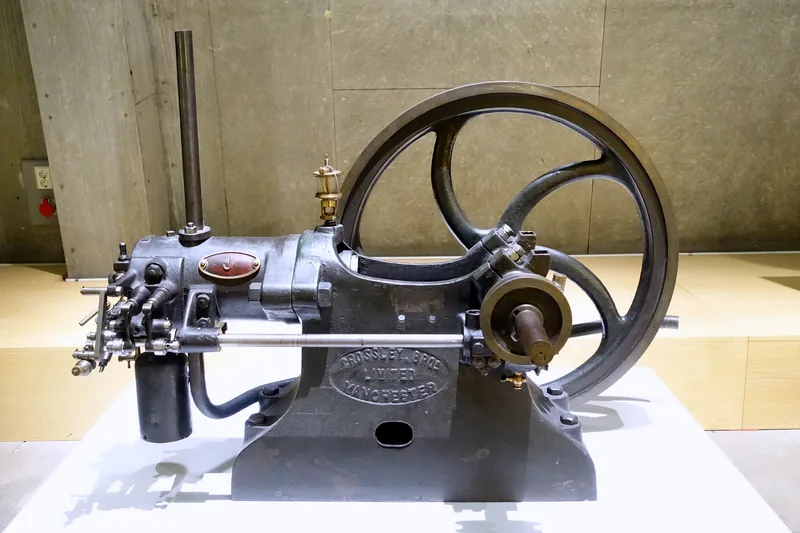
- The Crossley engine photographed on this site is object TM7415 at the Tekniska museet, a four-stroke coal-gas engine based on Otto’s design, manufactured 1876–1910, photographed by Daderot on 16 September 2014. The file is CC0 1.0. It is not Otto’s 1876 prototype.
- The Otto picture on this site is a plate from Nehemiah Hawkins’s New Catechism of the Steam Engine, 1904, scanned by Andy Dingley, and is in the public domain. It is a book illustration, not a photograph of a surviving engine.
- The early Diesel picture on this site is an illustration by Rankin Kennedy, 1903, of an engine with air-blast injection, scanned by Andy Dingley, and is in the public domain.
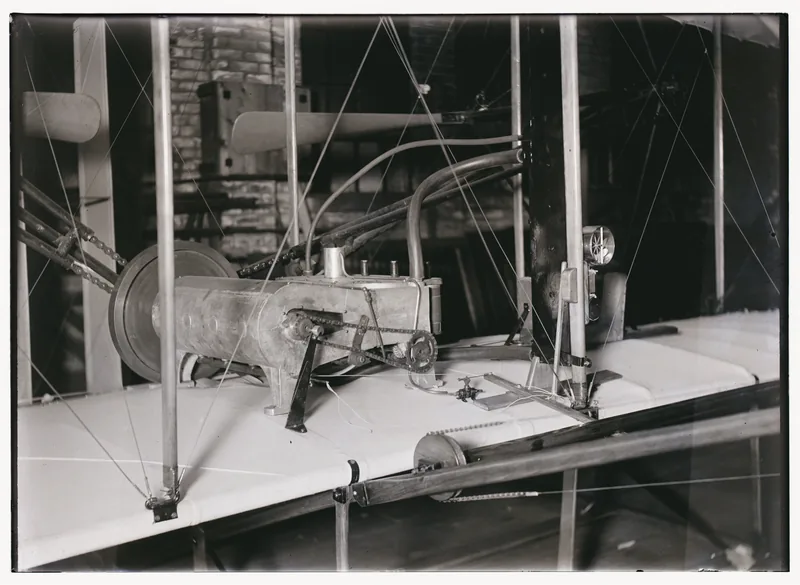
- The Wright engine-section photograph on this site was taken on 1 January 1928, before shipment to the Science Museum in London, is attributed to Orville Wright, and is Library of Congress digital ID ppprs.00651. It is a 1928 photograph of the 1903 motor.
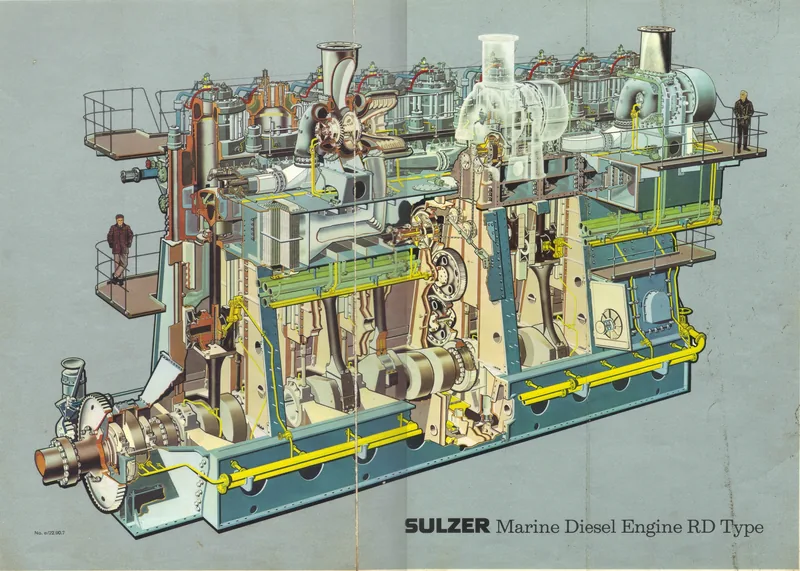
- A photograph released by Sulzer AG, in the public domain, shows a Sulzer RD marine diesel engine. This site does not attach a further official power or date to that picture beyond the file’s identification.
- A public-domain Commons file identifies one photographed motor as Liberty Aircraft Engine Number 1. The photographer is not named on the file page.
- A 1924 plate of Gnome et Rhône aero engines, scanned by EDHAC e.V., is in the public domain. It is a catalogue illustration, not a photograph of a single surviving engine.
- A photograph by Vitold Muratov, titled “First Diesel motor” on Commons, is used here under CC BY-SA 3.0 on the website only. This site does not treat that title as an official claim that the machine is Diesel’s first prototype.
- A public-domain Commons file identifies a photographed motor as a Packard V-1650 (Liberty 12-A inverted), and marks it as a USAF photograph. The photographer is not named on the file page.
- A public-domain Commons file identifies a photographed Ansaldo V-12 as coming from the airship Roma. The photographer is not named on the file page.
- NASA’s Otto-cycle page is part of the Beginner’s Guide to Aeronautics at NASA’s Glenn Research Center. [source]
- NASA’s mechanical-operation page is also part of the Beginner’s Guide to Aeronautics at NASA’s Glenn Research Center. [source]
- The Department of Energy page quoted here is “Internal Combustion Engine Basics.” [source]
- The Clerk quotations on this site come from the 1911 Encyclopaedia Britannica article “Oil Engine,” in the public domain, as published on Wikisource. [source]
- The Collier’s quotations on this site come from the 1921 Collier’s New Encyclopedia article “Diesel Engine,” in the public domain, as published on Wikisource. [source]
- NASA wording quoted on this site is U.S. government work. Diagrams on the NASA pages are not reproduced here. [source]
- Clerk wrote that Diesel’s heavy oil is injected “by a small portion of air compressed to a still higher point” than the already incandescent charge. [source]
- The Department of Energy says spark-ignition gasoline engines and compression-ignition diesel engines are the two kinds “currently in production,” and that most of these are four-stroke cycle engines. [source]
Enjoyed this piston-engine desk?
No pop-ups. No intrusive advertising. Just interesting stuff. A little support helps the next mechanics.im site get built.