Explore mechanics.im

For families

A piston, a shove, and four trips up and down

You do not need a workshop to follow the official story. A piston is a moving plug in a fixed tube. Fire in the tube shoves the plug, and the plug turns a shaft.
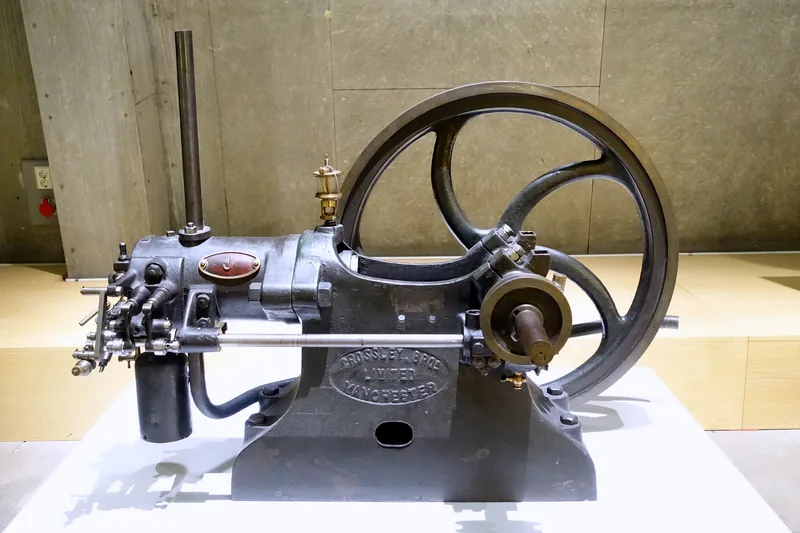
A Crossley Brothers four-stroke coal-gas engine, painted dark and standing on a wooden floor in a museum hall
A Crossley Brothers four-stroke coal-gas engine, based on Otto’s design, object TM7415 at the Tekniska museet in Stockholm, photographed by Daderot on 16 September 2014. It is a later Crossley engine, not Nikolaus Otto’s 1876 prototype. NASA says the Wright brothers’ design was based on early automobile engines that used the Otto cycle, developed by Dr N. A. Otto in 1876. The file is CC0 1.0. Photo: Daderot, 16 September 2014 · CC0 1.0 · Wikimedia Commons

NASA puts it in one pair of sentences. Fuel and air are ignited inside a cylinder. The hot exhaust gas pushes a piston, and that piston is connected to a crankshaft to produce power. Four trips of the piston — down, up, down, up — make one cycle. Those trips have names: intake, compression, power, exhaust. [source] [source]

A petrol engine, the Department of Energy says, mixes fuel with air, squeezes the mixture, and lights it with a spark. A diesel engine squeezes only air, then sprays in the fuel, and the hot air is enough to light it. [source]
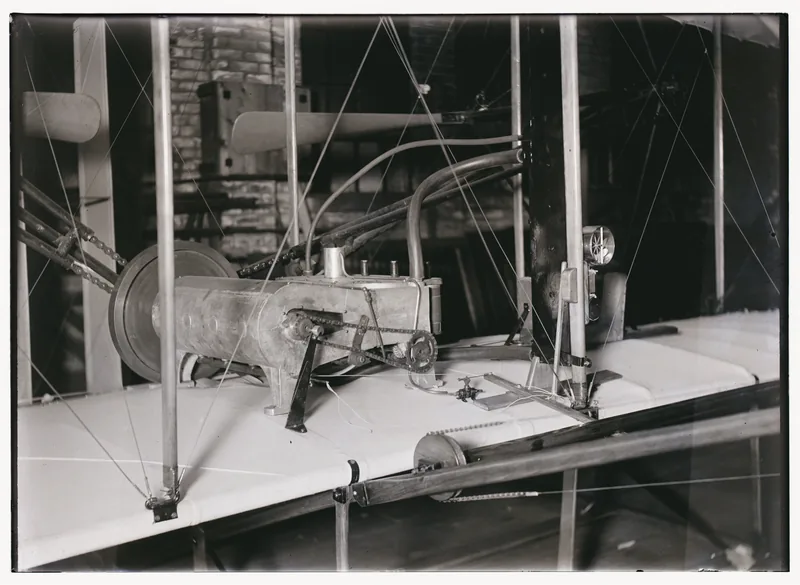
The central engine section of the 1903 Wright Flyer, photographed in the shop in 1928
The central engine section of the 1903 Wright Flyer, photographed in the shop on 1 January 1928, before shipment to the Science Museum in London, and attributed to Orville Wright. Library of Congress digital ID ppprs.00651. It is a 1928 photograph of the 1903 motor, not a photograph taken in 1903. NASA says that engine made about 16 horsepower when first started, and about 12 horsepower when it was running hot. The file is in the public domain. Photo: Attributed to Orville Wright, 1 January 1928. Library of Congress, digital ID ppprs.00651 · Public domain · Wikimedia Commons
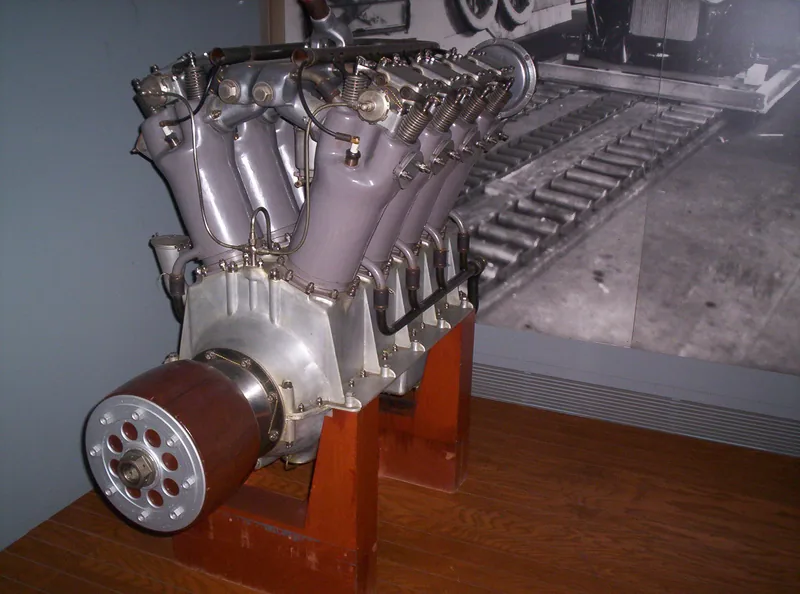
A Liberty aircraft engine, seen from the front, with its cylinder banks and propeller hub
A Liberty aircraft engine, identified on the Commons file as Liberty Aircraft Engine Number 1. The photographer is not named on the file page. The file is in the public domain. This site does not add a further official story to the picture beyond that identification. Photo: Photographer not named on the Commons file · Public domain · Wikimedia Commons

The Wright brothers’ motor, NASA says, was a gasoline four-stroke engine, based on the Otto cycle of 1876. When it was first started it made about 16 horsepower. When it was running hot it made about 12. Even a famous engine, the official page suggests, could lose power as it warmed. [source] [source]

The pictures on this site are of real machines and old book plates. The Crossley engine in the museum is based on Otto’s design, but it is not the first Otto engine. The Wright photograph was taken in 1928, of a 1903 motor. The Diesel picture is a 1903 illustration. Captions say so, so nobody has to guess.

Keep the lights on

Enjoyed this piston-engine desk?

No pop-ups. No intrusive advertising. Just interesting stuff. A little support helps the next mechanics.im site get built.