1876
Otto, and the cycle the Wrights borrowed
NASA does not tell Otto’s whole biography here. It gives a year, a name, and a line that still connects a German cycle to a bicycle shop in Dayton: the Wright brothers’ design “was based on early automobile engine designs which used the Otto cycle, developed by the German, Dr. N. A. Otto, in 1876.”
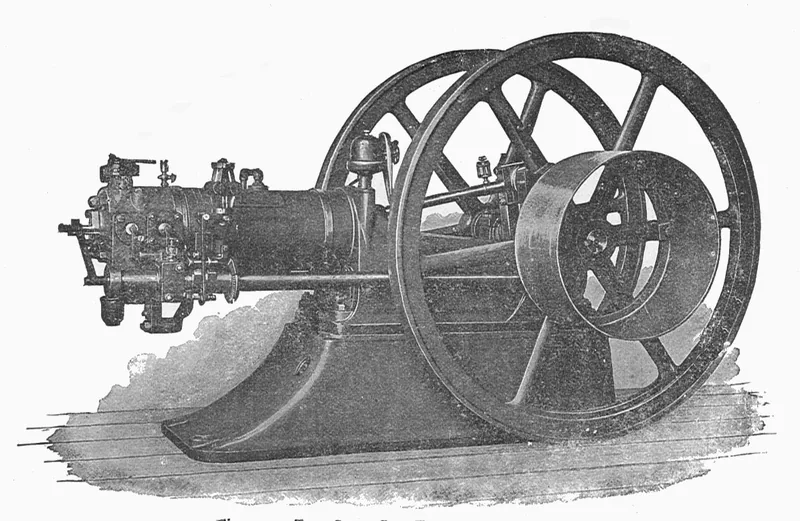
The plate on this page is later still — a 1904 book illustration of a horizontal Otto gas engine, from Nehemiah Hawkins’s New Catechism of the Steam Engine. It is not a photograph of the 1876 machine. It is a picture of how the idea looked, already familiar, in a turn-of-the-century handbook.
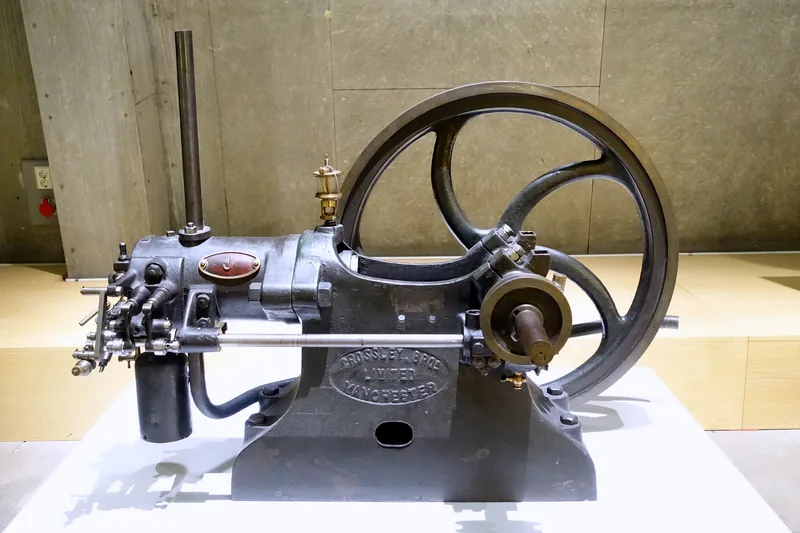
In Stockholm you can walk around a cousin of that idea. The Crossley Brothers four-stroke coal-gas engine at the Tekniska museet, object TM7415, was manufactured in the years 1876–1910 and is based on Otto’s design. It is not the prototype. It is evidence that the cycle left the inventor’s name and went into ordinary workshops, burning coal gas rather than petrol, turning a flywheel on a museum floor.
NASA’s mechanical-operation page stays with the Wright motor when it wants a single cylinder to talk about. Four cylinders, each piston connected to a common crankshaft; the crankshaft connected to two counter-rotating propellers. The official horsepower of that engine is kept to that engine: “about 16 horsepower when the engine was first started to about 12 horsepower when it was running hot.” Those figures are not generalised here to other Otto engines. [source] [source]
Clerk, writing in 1911, still used “the Otto cycle” as a working name for Diesel engines too. “The engine operates generally on the Otto cycle, but it is also built giving an impulse at every revolution.” A later page on this site keeps that wording with him, rather than deciding that “Otto” can only mean a spark-ignition motor. [source]
Enjoyed this piston-engine desk?
No pop-ups. No intrusive advertising. Just interesting stuff. A little support helps the next mechanics.im site get built.